MBA in Islamic Banking and Finance is a UK accredited, Level 7 online masters degree program for professionals seeking advanced expertise in Shariah compliant finance and business management. Offered by AIMS Education since 2005, it combines Islamic banking, financial products, governance, accounting, risk, leadership, and strategic decision making.

The Masters in Islamic Banking and Finance online is internationally recognized, aligned with AAOIFI standards, and career-focused, and flexible. Students do not need any prior knowledge or understanding of Islamic finance to begin the program. Students learn through 3D interactive lectures, comprehensive study manuals, case based assignments, faculty support, and a real world Islamic finance project that develops job ready understanding.

AIMS’ MBA Islamic finance prepares professionals to understand ethical finance, asset backed transactions, risk sharing, Shariah governance, and business leadership. It is valuable for learners who want career growth in Islamic banks, takaful operators, advisory firms, investment institutions, fintech, regulation, or academic progression.

Masters in Islamic Finance Program Objectives

  • Strengthen qualifications for high growth roles in Islamic banking, Islamic finance, takaful, and related financial services.

  • Develop advanced knowledge of AAOIFI Shariah compliant financial products, services, standards, and governance frameworks.

  • Build practical management capability in strategy, leadership, business analysis, and organizational decision making.

  • Prepares students to apply Islamic finance knowledge in commercial, advisory, compliance, investment and takaful.

  • Support flexible study for busy professionals who need a credible online route to a Islamic finance masters qualification.

  • Enable learners to earn respected professional certifications and diploma while progressing toward the Islamic finance degree.

MBA Islamic Finance: Accreditation, Recognition & Academic Progression

AIMS is a UK-registered and internationally accredited educational institution. This MBA in Islamic Banking and Finance is structured as a Level 7 postgraduate qualification and awards 45 credit hours. The program is designed for professionals seeking career growth in Islamic financial institutions, advisory firms, and higher education.

Globally Accredited and AAOIFI-Aligned Islamic Finance Masters

The curriculum aligns with AAOIFI Shariah and accounting standards and reflects current industry practice in Islamic financial services. AIMS is registered with the UK Register of Learning Providers (UKRLP) and holds international accreditation from QAHE and CPD.

The 45-credit-hour MBA Islamic Finance program combines specialist academic depth, recognized institutional standing, and international relevance for learners seeking an accredited Masters in Islamic Finance online.

UK Level 7 Qualification with Academic Progression

During this Level 7 Islamic Finance Masters program, students complete seven advanced Islamic finance courses, six business management courses, and a supervised project. This structure gives the MBA Islamic Banking and Finance degree both specialist depth and managerial breadth. During the program, students also earn Certified Islamic Banker, Certified Islamic Finance Expert, Certified Takaful Professional, and Master Diploma in Islamic Banking and Finance credentials, and successful MBA graduates may apply for the PhD in Islamic Finance.

Masters in Islamic Finance: Quick Review

Quick overview of the Masters in Islamic Finance online, including study format, duration, assessment, and embedded professional awards.
Mode of studyFully online, self paced learning
Average durationAround 12 to 14 months
Study resourcesInteractive lectures, detailed study manuals, faculty support, online assignments, and Islamic finance e library
Courses to study13 courses and 1 real world project
Weekly study loadAround 10 to 12 hours per week
AssessmentAssignments 35%, final exams 55%, project 10%
Awards during studyCIB and CIFE after Semester I, CTP and MDIF after Semester II
Final awardMBA in Islamic Banking and Finance

AIMS’ MBA in Islamic Banking and Finance Compared with Other MBA Programs

This comparison helps students evaluate important decision factors before choosing a program. AIMS’ Masters in Islamic Finance online program combines Islamic finance specialization, embedded certifications, AAOIFI aligned study, online flexibility, applied project work, interactive 3D lectures, learning resources, and progression value, while general alternatives may vary in depth and structure.

FeaturesAIMS’ MBA in Islamic Banking and FinanceOther MBA/Masters Programs
SpecializationFocused on Islamic banking, Shariah compliant finance, takaful, Sukuk, accounting, governance, and management.Focus mainly on general business with limited Islamic finance coverage.
Embedded awardsIncludes CIB, CIFE, CTP, and MDIF milestones during the MBA pathway.Certifications require separate enrollment and additional fee.
Standards alignmentCurriculum is aligned with AAOIFI Shariah and accounting standards.Islamic finance standards coverage is limited.
Learning formatOnline, self paced study with 3D interactive lectures, manuals, e library, assignments, and faculty support.Delivery may be campus based, fixed schedule, blended, or less flexible.
Practical applicationIncludes case based learning and a real world Islamic finance project.Applied Islamic finance project work is limited or optional.
Comparison of AIMS’ MBA in Islamic Banking and Finance with general MBA/Masters alternatives in the market.

How to Earn the MBA in Islamic Banking and Finance Online

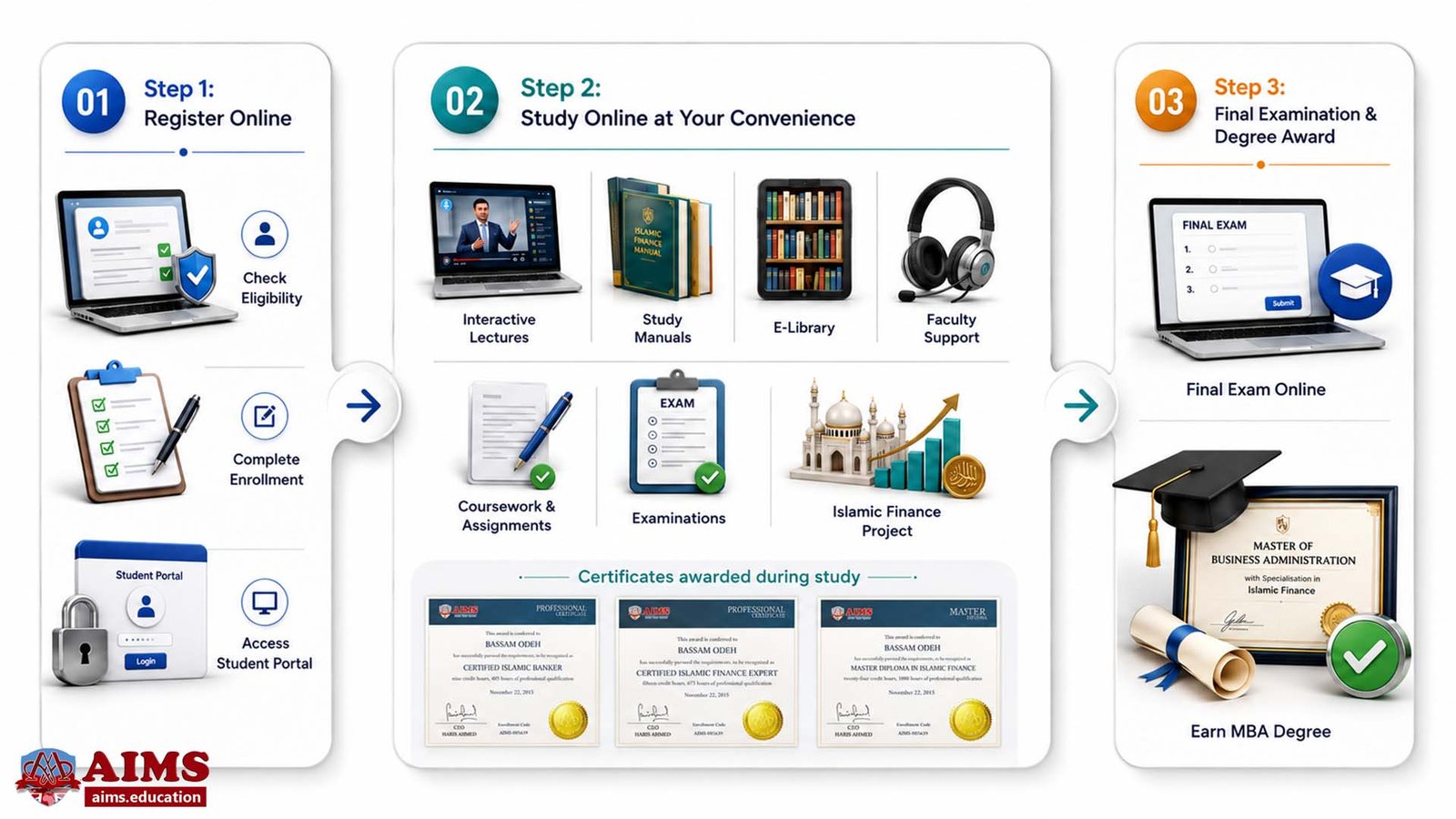
This Online Masters in Islamic Finance and Banking follows a flexible study process from registration to graduation. Students receive online portal access, study each course at their own pace, complete assignments and scheduled exams, and finish with a supervised Islamic finance project.

Applicants check eligibility, submit online registration, and complete the admission process. After review and approval, students receive confirmation and access to the online study portal, normally within 48 hours.

The learning model is fully online and flexible. Students access 3D interactive lectures, e manuals, online assignments, and an Islamic finance e library from any location. The Islamic finance masters starts from foundational concepts, so it supports both experienced professionals and learners entering the field for the first time.

  • Students complete two assignments for each course at their own pace.
  • Faculty support is available throughout the study journey.
  • Case studies and applied examples connect theory with professional practice.
  • Semester examinations are scheduled on a suitable date and time.
  • Assessments are designed to measure understanding, application, and practical readiness.

Students complete semester examinations and submit a real world Islamic finance project under faculty supervision. Final results are based on assignments, exams, and project performance. Students who successfully complete all requirements receive the MBA in Islamic Banking and Finance along with the academic transcript. Embedded certifications are awarded as students complete the relevant courses and semester requirements.

MBA in Islamic Banking and Finance online study process

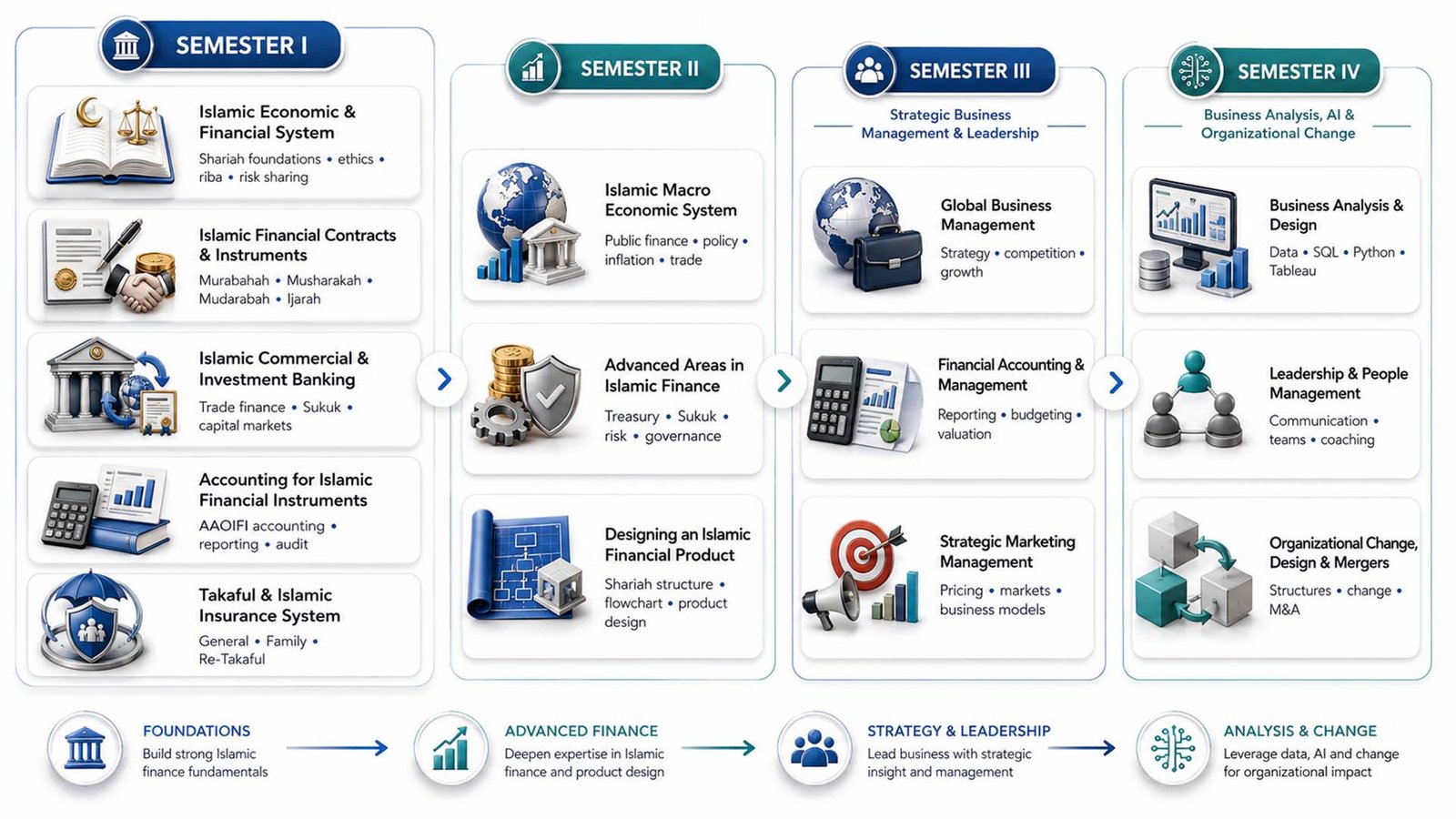
MBA Islamic Finance and Banking – Course Structure

The MBA Islamic Banking and Finance includes seven concentration courses in Islamic banking and finance, six business management core courses, and one supervised project. In credit terms, the structure combines 21 credit hours of Islamic finance specialization, 18 credit hours of business and management study, and 6 credit hours for the final project.
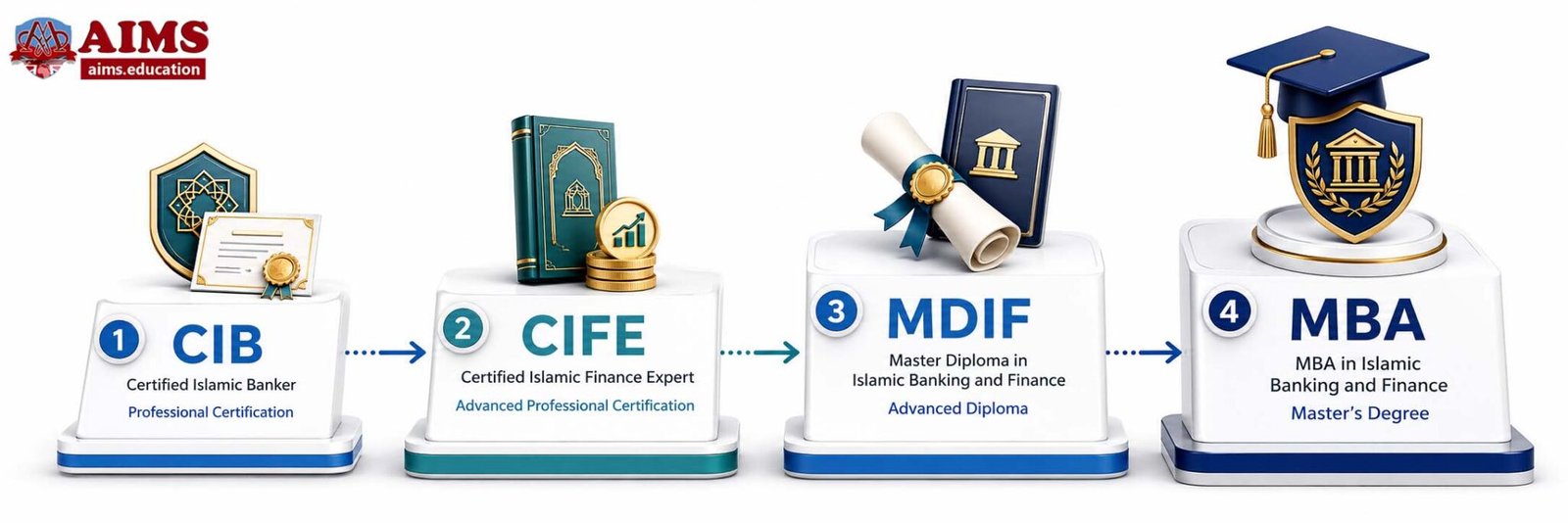
  • Semester-I Outcomes

    After successful completion of Semester I, students earn the Certified Islamic Banker (CIB), and Certified Islamic Finance Expert (CIFE). These awards strengthen early professional credibility while the Islamic finance degree continues.

  • Semester-II Outcomes

    After successful completion of Semester II, students earn the Certified Takaful Professional (CTP), and the Master Diploma in Islamic Banking and Finance (MDIF). This stacked structure gives students recognized milestones before final graduation.

  • Final Degree Award

    After completing all courses and the real world project, students receive the MBA Masters in Islamic Banking and Finance. The qualification can also support progression toward PhD research study in Islamic finance and banking.

Islamic Finance Masters qualification structure

Masters in Islamic Finance Curriculum Overview

The curriculum combines specialist Islamic finance education with broader business leadership capability. This structure helps students understand how Islamic financial institutions operate, how Shariah compliant products are structured, and how organizations are managed in competitive markets.

  • Islamic Economic and Financial System: Study Islamic economics, causes of financial inequality, and Shariah based approaches to wealth creation and distribution.
  • Islamic Financial Contracts and Modes of Finance: Learn the mechanisms and applications of Murabahah, Musharakah, Ijarah, Salam, Sukuk, and related instruments.
  • Islamic Commercial and Investment Banking: Understand Islamic banking operations, investment structures, and project finance from a Shariah compliant perspective.
  • AAOIFI Standards and Islamic Accounting Treatment: Develop knowledge of accounting treatment and AAOIFI based reporting principles for Islamic institutions.
  • Islamic Insurance, Takaful: Examine takaful structures, product models, policy design, and risk sharing arrangements.
  • Macro Economic System of Islam: Explore macroeconomic thought, public policy, fiscal approaches, and economic planning within Islamic principles.
  • Advanced Islamic Financial Services: Study Sukuk structuring, Shariah compliant trade finance, venture capital, risk management, and regulatory issues.
  • Designing an Islamic Financial Product: Apply industry knowledge to design practical Shariah compliant products for institutional use.
  • Global Business Management: Cover planning, negotiation, human resource management, organization, and international business strategy.
  • Financial Accounting and Management: Study budgeting, reporting, cost control, corporate finance, and management decision support.
  • Strategic Marketing Management: Learn how to align marketing, positioning, and business growth strategy within competitive financial markets.
  • Business Analysis and Design: Build analytical capability using modern tools and decision frameworks relevant to data driven organizations.
  • Leadership and People Management: Develop practical leadership skills in communication, conflict resolution, motivation, and team management.
  • Organizational Design, Change and Mergers: Study restructuring, change leadership, integration, and organizational transformation.

Capstone Project in Islamic Finance

The project applies Islamic banking and finance knowledge to a real professional scenario, such as product development, institutional analysis, Shariah compliance, takaful operations, risk improvement, or Islamic banking strategy. This project adds practical depth to the MBA Islamic Banking and Finance degree program.

Explore the MBA Islamic Finance Learning Experience

Preview how the MBA in Islamic Banking and Finance is delivered through interactive online 3D interactive lectures, structured coursework, and professionally recognized academic outcomes.

mba Islamic finance

Demo Lecture

A demo lecture helps prospective learners understand how advanced Islamic banking and finance topics are taught through structured, expert-led online learning.

MBA Islamic Finance semester coursework structure

MBA Islamic Finance Coursework

The coursework is designed to build practical understanding through guided study, applied assignments, and real-world Islamic finance analysis.

Who This Masters Is For and Where It Can Lead

Who Should Persue This MBA Masters in Islamic Banking and Finance Online?

The MBA in Islamic Banking and Finance is designed for professionals who want advanced knowledge of Islamic finance together with practical business and leadership skills. It is suitable for learners seeking career progression in Islamic banks, takaful companies, advisory firms, regulatory functions, and Shariah compliant financial services. The program also supports professionals from conventional finance backgrounds who want to transition into Islamic banking and finance through a structured and internationally relevant qualification.

Islamic finance is a global field built on ethical finance, asset backed transactions, risk sharing, and Shariah compliant financial practices. For this reason, the program is relevant to qualified learners from different professional and academic backgrounds.

  • Conventional bankers and finance professionals moving into Islamic finance
  • Islamic banking practitioners preparing for senior and leadership roles
  • Auditors, compliance officers, and Shariah review professionals
  • Investment, wealth management, and advisory professionals
  • Takaful, fintech, and financial services professionals
  • Entrepreneurs developing Shariah compliant financial ventures
  • Lecturers, trainers, and policy professionals in finance and business
  • Graduates seeking a specialist and career focused Islamic Finance MBA

Career Opportunities After the MBA in Islamic Banking and Finance

Graduates can progress into specialist and leadership roles across Islamic banks, takaful operators, advisory firms, investment institutions, compliance functions, and training organizations. The program develops expertise in Shariah compliant finance, Islamic financial products, governance, management, and strategic decision making, which are valued across the Islamic finance industry.

  • Shariah Compliance Manager
  • Islamic Finance Product Manager or Structurer
  • Risk and Governance Manager
  • Takaful Manager
  • Investment Banking or Capital Markets Specialist
  • Treasury and Liquidity Manager
  • Islamic Wealth and Advisory Consultant
  • Shariah Auditor or Assurance Specialist

Career outcomes depend on prior experience, location, employer, and market conditions. The qualification is also valuable for specialized advisory work, and leadership responsibilities in Islamic financial institutions.

Student Experiences and Alumni Success

“The MBA in Islamic Banking and Finance transformed my understanding of Islamic finance. The curriculum, expert faculty, interactive lectures, e-manuals, assignments, and real-world project helped me apply concepts through practical case studies.”

Tovah Mutukura, Finance Advisor, Australia

“The MBA in Islamic Banking and Finance from AIMS helped me develop both theoretical knowledge and practical skills. The curriculum, interactive lectures, and real world project strengthened my professional expertise and made the learning highly relevant.”

Sarah Ahmed, Senior Banker, Canada

“I wanted an internationally respected master’s qualification in Islamic banking and finance, and the program gave me exactly that. It also prepared me for further research study and gave me confidence in the global recognition of my qualification.”

Mohammed Ali, Consultant, United Kingdom

“I earned CIB, CIFE, and MDIF during my studies, and those credentials added real value to my leadership role. As a full time professional and mother, the flexible online format allowed me to balance work, family, and study without compromise.”

Musa Kamara, Nigeria

Key Benefits of AIMS’ Masters in Islamic Finance Online

  • Earn Multiple Professional Credentials While You Study

    Students do not need to wait until graduation to gain recognition. The MBA includes CIB, CIFE, CTP, and MDIF within its program structure, giving learners valuable credentials as they complete their Islamic finance degree.

  • Study Flexibly Without Pausing Your Career

    The self paced online format is designed for working professionals. Students can study from anywhere, organize their weekly schedule around personal commitments, and access learning resources throughout the program.

  • Multiple Support Resources

    Students learn through a combination of online 3D interactive lectures, guided reading, assignments, and faculty interaction. Study materials are organized for independent learning, while expert support helps students move through complex topics such as Islamic contracts, AAOIFI standards, product structuring, and financial management.

  • Build Credibility in AAOIFI Oriented Practice

    AAOIFI alignment gives the program strong relevance for professional settings where Shariah compliance, reporting standards, governance, and structured product knowledge matter. This makes the Masters in Islamic Banking and Islamic program particularly valuable for career growth in regulated and specialist environments.

  • Learn a Curriculum Built for Industry Practice

    The curriculum combines Islamic financial instruments, accounting, takaful, regulation, and product design with leadership, management, and analytical skills. This balance helps graduates perform effectively in real institutional environments.

  • Progress Toward Leadership and Higher Study

    The 45-credit-hour structure strengthens promotion prospects and also supports learners who want to continue toward advanced academic studies in Islamic finance and banking.

  • Practical Learning and Faculty Expertise

    The curriculum is developed by experienced Shariah scholars and industry experts. Students do not study theory in isolation. They work through case based content, applied scenarios, and a final project that develops decision making skills for real institutional environments. This strengthens the credibility of AIMS’ online MBA Islamic Banking and Finance and addresses the common misconception that online study is less rigorous than campus based learning.

  • Career-Focused Islamic Finance and Management Curriculum

    The program covers Islamic economics, Islamic modes of finance, accounting standards, takaful, product development, strategic management, leadership, and business analysis. It is suitable for learners who want to enter Islamic finance, strengthen their current role, or prepare for advanced research and leadership roles in Islamic financial institutions.

Apply for the MBA in Islamic Banking and Finance

This Masters in Islamic Finance online degree program offers a clear route into advanced Islamic finance practice, professional recognition, and leadership development. Prospective learners can review the curriculum, request the brochure, explore the free Islamic finance lectures, check MBA fee and eligibility requirements and begin the application process. A 35% scholarship opportunity is also available for students.

    Frequently Asked Questions

    An MBA in Islamic Banking and Finance is a specialized masters degree program that combines Islamic economics, Shariah compliant finance, and business management. It prepares learners for leadership and specialist roles in Islamic financial institutions and related sectors.

    This program studies conventional MBA areas such as strategy, leadership, management, and analysis, but adds specialist Islamic finance content such as Murabahah, Musharakah, Sukuk, Takaful, Islamic accounting, and AAOIFI standards.

    The average duration is about 12 to 14 months. AIMS’ flexible study model allows students to progress at a pace that suits their schedule.

    Students earn CIB and CIFE after Semester I, CTP and MDIF after Semester II, and the final MBA in Islamic Banking and Finance after completing all courses and the project.

    Yes. The program is positioned as a UK accredited, Level 7 qualification offered by an internationally accredited institution. It is also aligned with AAOIFI standards and supported by structured online learning, faculty guidance, and successful graduate outcomes.

    No. The program begins with foundational concepts and is designed to support both experienced professionals and learners who are new to Islamic finance.

    No. Islamic finance is a global professional field based on ethical finance, risk sharing, and asset backed principles. The program is open to qualified learners from different backgrounds.

    Students study Islamic economics, Islamic modes of finance, investment and commercial banking, Islamic accounting, takaful, product development, business management, financial management, strategic marketing, business analysis, leadership, and organizational change.

    Graduates can pursue roles in Shariah compliance, Islamic finance product development, risk and governance, takaful management, investment and capital markets, treasury, advisory, audit, and training.

    Yes. The MBA in Islamic Banking and Finance is a Level 7 master’s-level qualification that may support further PhD study in Islamic finance and banking at AIMS and other higher education institutions, subject to admission rules, research suitability, and eligibility requirements.
    Yes. AIMS graduates are working in government departments, Islamic banks, financial institutions, corporate organizations, consulting firms, educational institutions, and international business environments around the world. The value of the MBA comes from its structured Islamic finance curriculum, UK registration, QAHE and CPD accreditations, AAOIFI-aligned learning, business management courses, practical assessments, and real-world project work.
    Yes. Embassy legalization and apostille services are available for AIMS MBA awards where required for international use. The duration may depend on the destination country.

    Students can apply through the online enrollment form, where they confirm their eligibility and complete the fee payment as part of the admission process. Once the eligibility requirements are met, enrollment can be completed directly, and the admissions process begins. After confirmation, students receive their login credentials and access to the study portal.