
Islamic Accounting is a Shariah-based approach to measuring, recording, and presenting financial information. It is not limited to avoiding interest. It also seeks fairness in profit allocation, clarity in contractual rights, accountability to investors and depositors, and responsible disclosure of social obligations such as zakat. In practical terms, Islamic Accounting asks a deeper question than conventional reporting often does: not only whether a transaction earned money, but whether it earned money in a lawful, transparent, and socially responsible way.
This makes Islamic accountancy especially important in Islamic banking and finance, where contracts are built around trade, leasing, partnership, agency, and asset-backed activity rather than interest-bearing debt. Because the structure of the transaction changes, the accounting logic also changes. Income must be linked to lawful commercial activity, prohibited earnings must be disclosed distinctly, and the rights of shareholders, unrestricted investment account holders, restricted investors, and society must be reflected more carefully than in a purely shareholder-centered model.
Modern Islamic financial accounting developed because Islamic banks could not simply copy conventional accounting rules without adjustment. Their deposits, investment accounts, profit-sharing arrangements, zakat responsibilities, and disclosure needs required clearer standards. That need eventually helped shape the development of AAOIFI guidance and broader discussions on how AAOIFI official site for Islamic finance standards fits alongside international reporting practice.
What Is Islamic Accounting?
Definition and Scope in Islamic Financial Accounting
Islamic financial accounting is the discipline of identifying, classifying, measuring, and reporting financial events in a way that remains consistent with Shariah principles. It covers the familiar accounting areas of assets, liabilities, equity, income, expenses, and disclosure, but it applies additional filters. A balance sheet item must not only be measurable and economically beneficial, it must also be valid from the Shariah point of view. That is why interest receivable, for example, is not treated the same way in Islamic banking.
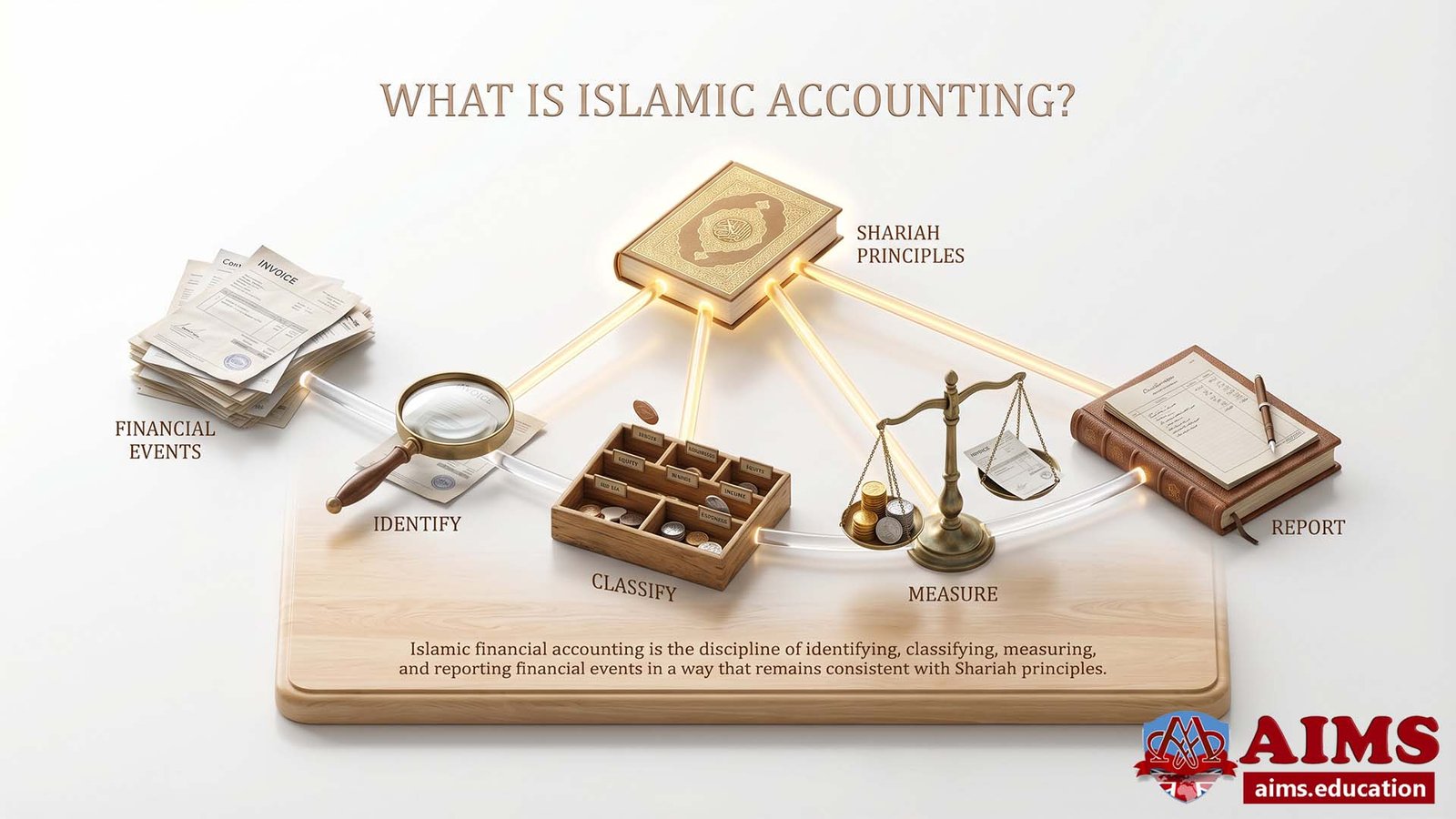
The scope of Islamic financial accounting extends beyond technical bookkeeping. It includes presentation of prohibited transactions, treatment of unrestricted and restricted investment accounts, disclosure of zakat-related responsibilities, and reporting on whether the institution operated within lawful contractual boundaries. It also pays close attention to how profits and losses are shared across different stakeholders.
Objectives of Shariah Accounting
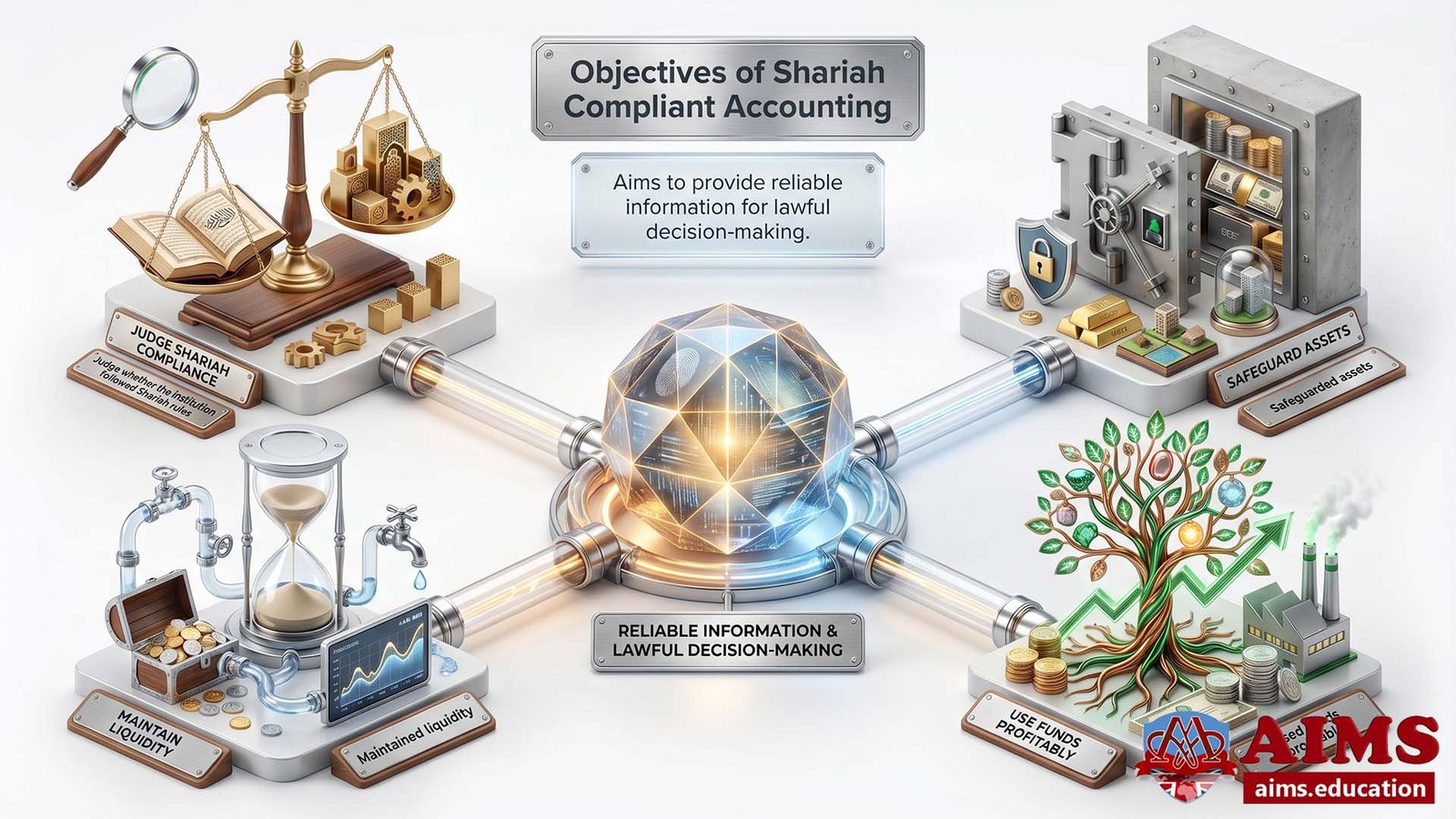
Shariah accounting aims to provide reliable information for lawful decision-making. It helps users judge whether the institution followed Shariah rules, safeguarded assets, maintained liquidity, used funds profitably, and fulfilled its obligations toward depositors, investors, employees, and society. In that sense, Shariah accounting serves both financial efficiency and moral accountability.
It also supports a broader understanding of stewardship. In Islamic banking, management is not answerable only for profit. It is also answerable for how profit was generated, whether prohibited income was isolated, whether social duties were disclosed properly, and whether those entitled to returns or bearing losses were treated justly. Readers who want structured learning support on these foundations may also review Comprehensive Islamic banking and finance study notes.
Fundamental Principles of Islamic Accounting
Islamic Accountancy and the Prohibition of Riba
One of the first rules in Islamic accountancy is that riba cannot be recognized as legitimate earning. This changes both classification and disclosure. Conventional systems normally recognize interest receivable or interest income as ordinary financial items. Islamic institutions must separate prohibited earnings instead of treating them as normal revenue.
That distinction is not cosmetic. It changes how assets are recognized, how income is presented, and how users assess the institution’s compliance. A lawful return in Islamic finance must arise from trade, lease, investment participation, or another valid contract, not from a guaranteed increase on debt. For a deeper foundation, see Riba (usury) in Islam.
Avoiding Gharar and Maysir in Shariah-Compliant Accounting
Shariah-compliant accounting also operates in a framework that rejects excessive uncertainty and gambling-like speculation. This matters because accounting reflects contract structure. If the underlying arrangement is too uncertain, deceptive, or speculative, the reporting cannot simply ignore that problem and present the result as ordinary lawful business income.
In practice, this encourages clearer documentation, asset linkage, and fuller disclosure. Shariah-compliant accounting therefore supports contractual clarity, not only numerical accuracy. It requires the accountant to understand the substance of the underlying Islamic finance transaction rather than recording it mechanically.
Profit-and-Loss Sharing in Islamic Financial Accounting
Islamic financial accounting places strong emphasis on risk sharing. When funds are invested through mudarabah or musharakah, profit allocation must reflect the agreed structure, while losses must follow the actual economic responsibility of the parties. This is a major difference from interest-based reporting, where the financier’s return may be fixed regardless of business outcome.
In Islamic banks, unrestricted investment account holders are not treated as ordinary owners, yet they are also not the same as conventional depositors expecting fixed interest. Their returns depend on investment results. Islamic financial accounting therefore has to disclose their position distinctly, because their funds participate in business outcomes in a way that ordinary bank deposits in conventional systems do not.
Justice, Benevolence, and Social Responsibility in Shariah Accounting
Shariah accounting is shaped by justice and benevolence. Justice requires truthful measurement, fair allocation of returns, and recognition of rights and obligations without exploitation. Benevolence adds a wider ethical layer by reminding institutions that finance should serve society rather than become detached from human welfare.

This is why Shariah accounting is closely connected to zakat, charitable responsibility, and social disclosure. Islamic reporting is expected to help users determine zakat liability and understand the institution’s conduct toward employees, customers, society, and the environment. A solid grasp of these principles begins with understanding Shariah law and sources of Shariah.
Islamic Accounting Standards and the Regulatory Framework
AAOIFI and Islamic Accounting Standards
Islamic accounting standards emerged because Islamic banks needed a framework that matched their actual contracts and stakeholder structure. AAOIFI became the best-known standard-setting reference in this field. Its standards help institutions present and disclose financial information in a way that reflects Shariah-compliant structures such as Murabaha, Ijarah, profit-sharing deposits, Zakah, and Istisna.
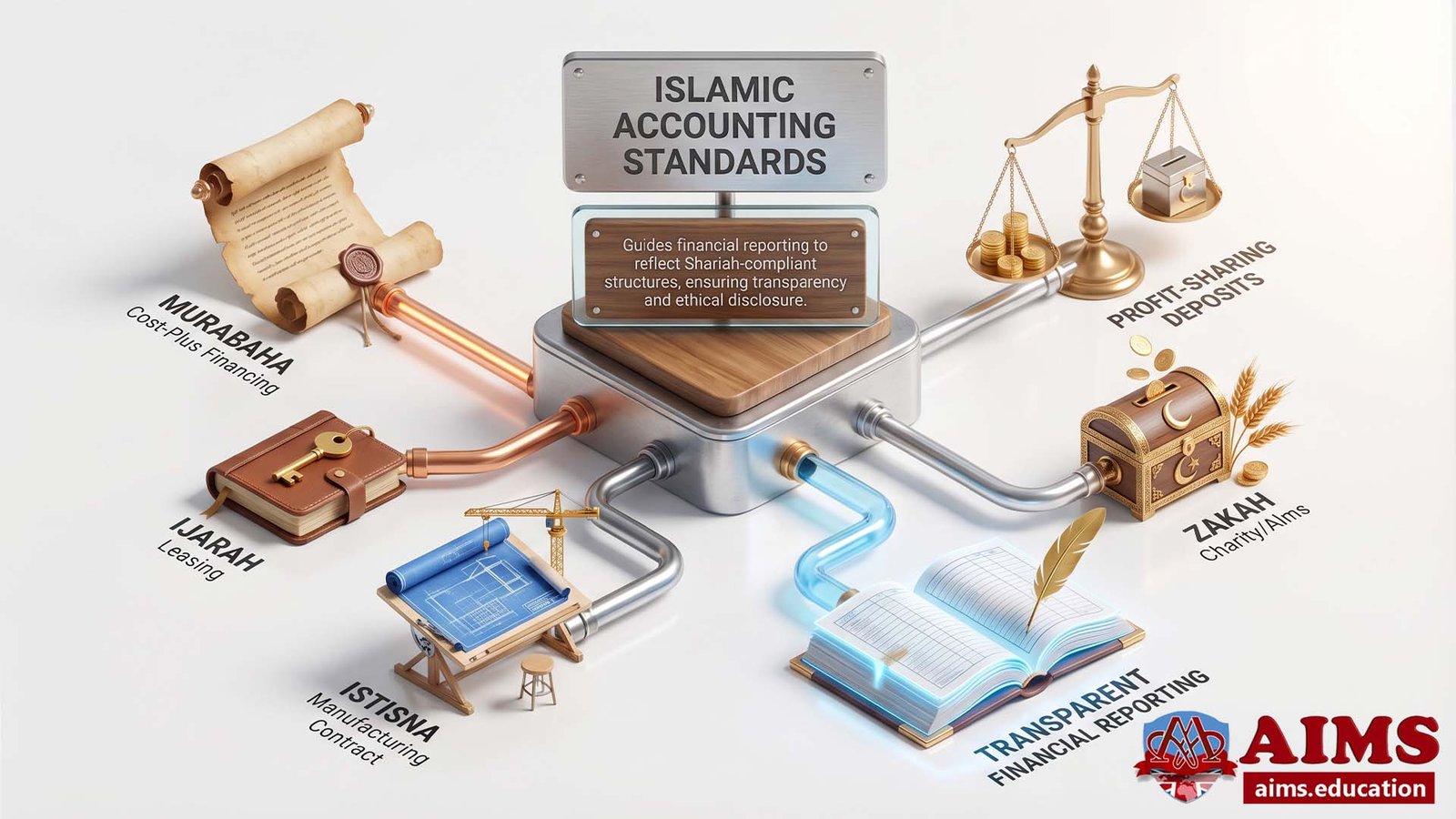
In teaching and practice, Islamic accounting standards are important because they reduce confusion across institutions and improve comparability. They also help accountants distinguish between income belonging to shareholders, income allocated to investment account holders, prohibited earnings, and funds handled in a fiduciary or agency capacity.
Shariah-Compliant Accounting and the Role of Disclosure
Shariah-compliant accounting depends heavily on disclosure. Users need to know whether the bank followed Shariah rules, what risks it took, how it allocated profits, whether it earned any prohibited income, and how it handled zakat and Qard al-Hasan funds. This disclosure focus is much broader than a narrow earnings-per-share mindset.
Typical statements discussed in Islamic banking include the balance sheet, income statement, statement of sources and uses of funds, statement of Qard al-Hasan fund, statement of sources and uses of zakat funds, and a statement of prohibited transactions. Even when some disclosures are merged into broader statements, the underlying idea remains the same: lawful conduct must be visible in the reporting.
IFRS and Islamic Financial Accounting
IFRS remains important because many Islamic financial institutions operate in jurisdictions where international reporting frameworks apply. The real issue is not whether Islamic financial accounting rejects global standards. It does not. The real issue is whether those standards, by themselves, fully capture the special features of Islamic contracts and Shariah governance.
That is why discussion often centers on harmonization rather than replacement. Islamic financial accounting may use international reporting discipline while adding contract-specific, compliance-specific, and social-responsibility-specific disclosures that conventional frameworks do not naturally emphasize. The strongest approach is not imitation of conventional practice, and not isolation from it either. It is disciplined integration with Shariah safeguards.
Islamic vs Conventional Accounting
Philosophical Foundations
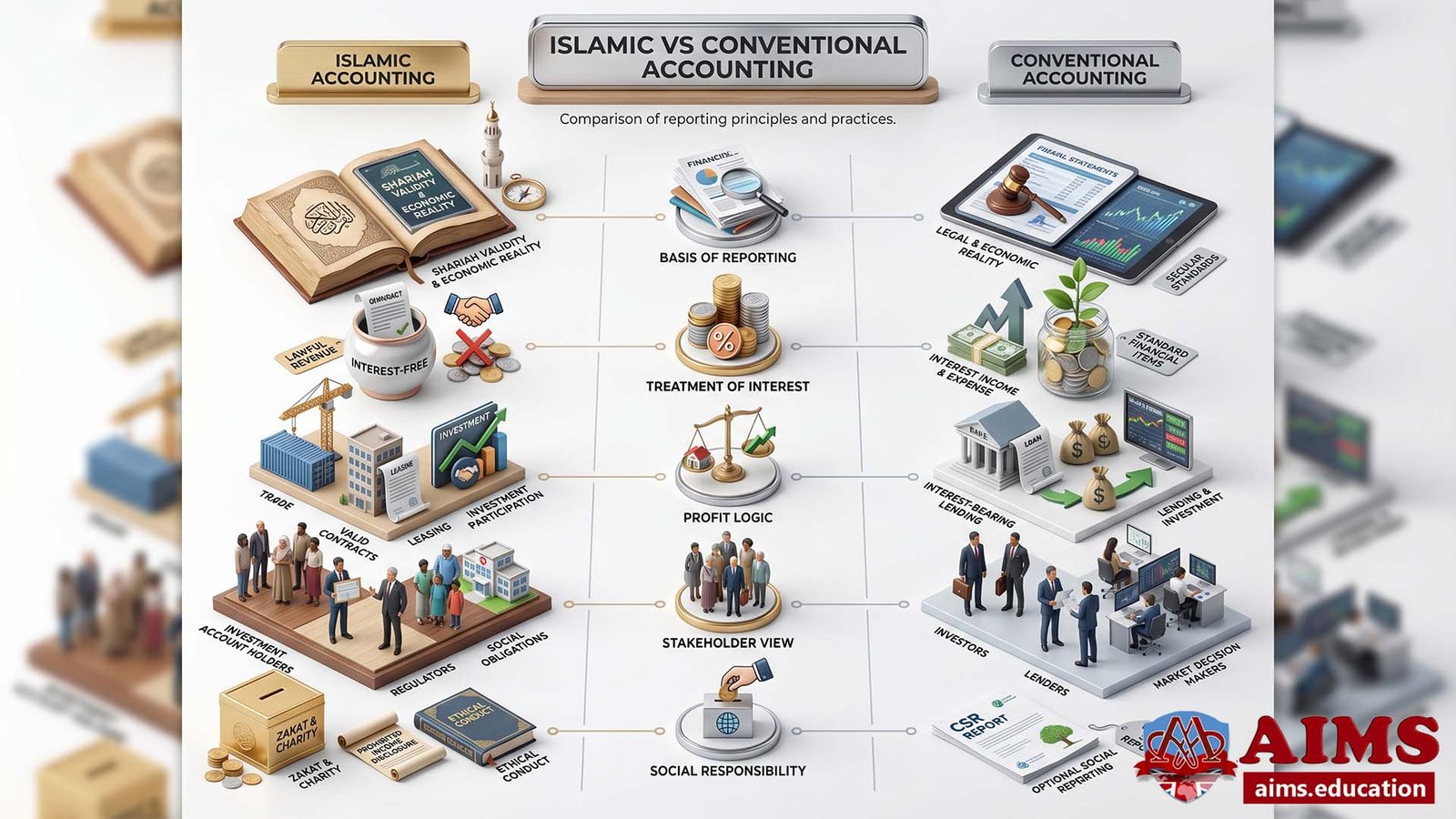
Conventional accounting grew within a secular commercial environment that mainly prioritizes investor decision usefulness and profit measurement. Islamic Accounting works within a religious and ethical framework that also asks whether transactions are lawful, whether rights are justly distributed, and whether wider social obligations have been respected.
Treatment of Interest and Profit
Conventional systems accept interest as ordinary revenue or expense. Islamic Accounting does not. Lawful income must come from sale, lease, partnership, agency, or other valid commercial activity. This difference changes recognition, presentation, and the meaning of performance itself.
Stakeholder Focus
Conventional accounting often gives dominant attention to shareholders and creditors. Islamic Accounting serves shareholders too, but it also pays serious attention to unrestricted investment account holders, restricted investors, zakat-related responsibilities, Shariah regulators, and social accountability.
| POINT OF DIFFERENCE | ISLAMIC ACCOUNTING | CONVENTIONAL ACCOUNTING |
|---|---|---|
| Basis of Reporting | Financial reporting must reflect Shariah validity as well as economic reality. | Financial reporting mainly reflects legal and economic reality within secular standards. |
| Treatment of Interest | Interest-based income is not recognized as lawful ordinary revenue. | Interest income and expense are recognized as standard financial items. |
| Profit Logic | Returns should arise from trade, leasing, investment participation, or other valid contracts. | Returns may arise from interest-bearing lending as well as trading and investment activity. |
| Stakeholder View | Reporting addresses owners, investment account holders, regulators, and social obligations. | Reporting focuses mainly on investors, lenders, and market decision makers. |
| Social Responsibility | Zakat, prohibited income, and ethical conduct require visible disclosure. | Social reporting may exist, but it is not built into the same religious accountability structure. |
These reporting distinctions sit alongside the wider key differences between Islamic and conventional banking, which explain why the accounting treatment cannot be identical.
Islamic Finance Transactions and Their Accounting Logic
Murabaha in Islamic Accountancy
Murabaha is a sale contract in which the seller discloses cost and profit margin. In Islamic accountancy, the return comes from trade profit, not interest on a loan.
Example:
- Al-Noor Bank purchases equipment for $50,000.
- The bank sells it to Sana Traders for $58,000 on deferred payment terms.
- The asset is first recognized as inventory or a similar sale-related asset while owned by the bank.
- Once the sale is completed, the bank recognizes a receivable of $58,000 and a trade profit of $8,000 according to the applicable recognition basis.
- The return is linked to a real sale, so it is reported as commercial profit rather than interest income.
This example shows how Islamic accountancy connects income to a lawful sale rather than a debt-based increase.
Musharakah and Mudarabah in Islamic Financial Accounting
Musharakah is partnership financing, while mudarabah combines capital from one party with management from another. Islamic financial accounting must show how profit is allocated and who bears loss.
Example:
- Barakah Ventures invests $100,000 in a mudarabah project managed by Hadi Foods.
- The agreed profit-sharing ratio is 60 percent to the investor and 40 percent to the manager.
- The project earns a profit of $20,000.
- The investor recognizes $12,000 as its share, while the manager recognizes $8,000 as its mudarabah income.
- If the project incurs a genuine business loss without misconduct, the capital investor bears the financial loss, while the manager loses the effort already spent.
This example shows how Islamic financial accounting ties reward to risk and preserves the economic logic of partnership.
Ijarah and Shariah-Compliant Accounting
Ijarah is lease-based financing. In Shariah-compliant accounting, the earning arises from usufruct, meaning the lawful transfer of asset use, not from interest on cash lending. That distinction matters because the lessor retains asset-related responsibilities consistent with the contract structure.
Example:
- Rahma Bank buys delivery vehicles for $80,000.
- It leases them to Aman Couriers for monthly rentals.
- The vehicles remain recognized within the appropriate asset framework while the bank owns them.
- Lease income is recognized from the lease arrangement, while prohibited financing-lease income, if structured unlawfully, must be disclosed separately.
This example shows how Shariah-compliant accounting records lease returns as income from asset use rather than from lending money.
Sukuk and Zakat Accounting
Sukuk are often described as Islamic alternatives to bonds, but they are not simply bonds with Arabic names. Their reporting depends on the underlying asset, usufruct, or investment structure. Zakat accounting also requires separate thought because zakat is a religious obligation, not a normal commercial tax.
One strong view in Islamic accounting literature holds that zakat should not be treated merely as an ordinary operating expense. The concern is that doing so can reduce the base subject to zakat and distort the social purpose of the obligation. Instead, zakat requires its own careful treatment, policy disclosure, and presentation according to the institution’s role and the governing standard.
Applications of Islamic Accounting in Practice
Islamic Banks and Deposit Structures
Islamic banks deal with current accounts, unrestricted investment accounts, and restricted investment accounts in different ways. That alone makes their reporting architecture more complex than a conventional bank that mainly separates deposits, loans, and shareholders’ equity.
Islamic Accounting must show who owns funds, who shares in results, and who merely places funds for safekeeping or payment services. That is why unrestricted investment account holders occupy a special place in Islamic bank reporting.
Islamic Windows, Funds, and Shariah Audit
Where conventional banks operate Islamic windows, dual reporting challenges appear. The institution must avoid mixing prohibited earnings with lawful Islamic income, and it must maintain contract-level clarity. Islamic investment funds and takaful arrangements add further disclosure needs because they involve fiduciary handling, participant interests, and compliance oversight.
Shariah audit and supervisory review therefore become more than ceremonial governance. They help confirm that the accounting treatment matches the actual legal and ethical nature of the transaction. For professionals building expertise in this area, International MBA in Islamic Banking & Finance and broader Islamic finance courses for career growth can provide structured pathways.
Challenges and the Future of Shariah-Compliant Accounting
Standardization and Interpretation
One challenge in Shariah-compliant accounting is that practice can vary across jurisdictions, institutions, and schools of interpretation. Even when broad principles are shared, the detailed treatment of profit recognition, impairment, disclosures, and governance may differ.
Training and Technical Capacity
Another challenge is talent. Good accounting alone is not enough, and Shariah literacy alone is not enough. Strong Islamic accounting requires professionals who understand both accounting standards and Islamic contracts in operational detail.
Technology and Product Innovation
Fintech, digital documentation, smart audit tools, and more complex Sukuk and structured products are pushing Islamic Accounting into new territory. The next phase will likely reward institutions that combine strict compliance discipline with faster, clearer, and more transparent reporting systems.
FAQs on Islamic Accounting
What Is the Definition of Islamic Accounting?
Islamic Accounting is a Shariah-based system of financial reporting that records and presents transactions in a way that reflects lawful income, fair profit allocation, transparency, and social accountability.
Why Is Interest Forbidden and How Is Profit Recognized Instead?
Interest is prohibited because a guaranteed increase on debt is not treated as lawful commercial earning in Islamic finance. Profit is recognized through valid sale, lease, partnership, agency, or investment structures where return is linked to real economic activity and risk.
What Role Does AAOIFI Play in Islamic Accounting Standards?
AAOIFI provides specialized accounting, auditing, governance, and Shariah standards for Islamic financial institutions. Its guidance helps institutions present Islamic finance transactions in a more consistent and contract-appropriate way.
How Does Islamic Accounting Ensure Social Justice and Transparency?
It requires clearer disclosure of prohibited income, profit allocation, zakat-related obligations, investment account structures, and social responsibilities. This broadens accountability beyond pure shareholder profit.
What Are Common Misunderstandings About Islamic Accounting?
A common misunderstanding is that it only means banning interest. In reality, it also reshapes disclosure, contract analysis, stakeholder accountability, profit measurement, and treatment of social obligations. Another misconception is that it ignores international practice, when in fact many institutions work with international standards alongside Islamic-specific guidance.
How Are Zakat and Charity Reflected in Financial Statements?
Zakat is not simply another routine tax item. It requires separate policy treatment and careful disclosure, especially where the institution calculates, collects, administers, or pays zakat through dedicated funds or statements.
Conclusion
Islamic Accounting is best understood as ethical financial reporting with contractual precision. It protects the meaning of lawful profit, makes prohibited earnings visible, clarifies the position of investors and depositors, and connects finance to justice and accountability. That is why Islamic accountancy remains essential for serious Islamic banking and finance practice. Without it, Shariah-compliant products may look Islamic in form while remaining weak in measurement, disclosure, and accountability.
About the Author
AIMS’ Institute of Islamic Banking and Finance has been advancing Islamic Banking and Finance education globally since 2005. Its work bridges classical Fiqh with modern banking, accounting, and financial practice through scholarly depth and industry relevance for learners worldwide. Explore the institute through AIMS’ Institute of Islamic Banking and Finance.